> For the complete documentation index, see [llms.txt](https://docs.g-iot.io/llms.txt). Markdown versions of documentation pages are available by appending `.md` to page URLs; this page is available as [Markdown](https://docs.g-iot.io/low-cost-tracker-full-device-guide-book/low-cost-tracker-greater-than-giots-functions/lct-rules/lct-increase-severity-rule.md).
# LCT - Increase Severity Rule
The **Increase Security Rule** is designed to **continuously monitor active alarms** and escalate their severity level over time if they remain unresolved. At each defined **time interval**, the rule checks whether the alarm is still in an **ON (active) state**. If the alarm persists, the system automatically increases its severity level step by step until it reaches the highest level of **Critical**. This rule enhances security by ensuring that prolonged or unattended alarms receive heightened attention, prompting quicker action to mitigate potential risks.
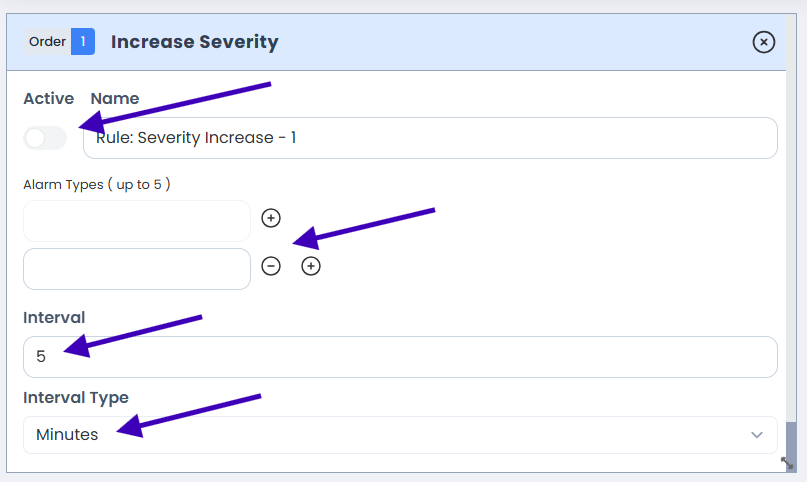
Increase Severity
## Steps to Set Up the Increase Severity Rule for LCT:
1. **Go to Device:**\
Navigate to the **device list**, locate the desired LCT device, and open its **dashboard**.
2. **Access Rules Section:**\
Open the **Rules** section of the device dashboard, click on the **+ icon**, and select the **Increase Severity**.
3. **Activate Rule:**\
Toggle the switch to activate the rule.
4. **Insert Rule Name:**\
Enter a meaningful name for the rule.
5. **Insert Alarm Type**\
Use the + icon to add more than one type, up to five types max.
6. **Specify the interval:**\
Insert the numerical value of the interval.
7. **Define Interval Type:**\
Select if the interval will be in Minutes or Hours
8. **Save Configuration:**\
Click **Save** to apply and activate the rule.
---
# Agent Instructions
This documentation is published with GitBook. GitBook is the documentation platform designed so that both humans and AI agents can read, navigate, and reason over technical content effectively. Learn more at gitbook.com.
## Querying This Documentation
If you need additional information that is not directly available in this page, you can query the documentation by asking a question.
Perform an HTTP GET request on the following URL with the `ask` and `goal` query parameters:
```
GET https://docs.g-iot.io/low-cost-tracker-full-device-guide-book/low-cost-tracker-greater-than-giots-functions/lct-rules/lct-increase-severity-rule.md?ask=&goal=
```
`ask` is the immediate question: it should be specific, self-contained, and written in natural language.
`goal` is what the user is ultimately trying to achieve, the reason they need the answer. Sharing it helps GitBook give you a better, more relevant answer. A goal is most helpful when it describes the outcome the user wants rather than restating the question. For example, with `ask=how do I create an API token`, a goal like `automate deployments from our CI pipeline` lets GitBook tailor the answer to that use case.
The response will contain a direct answer to the question and relevant excerpts and sources from the documentation.
Use this mechanism when the answer is not explicitly present in the current page, you need clarification or additional context, or you want to retrieve related documentation sections.