> For the complete documentation index, see [llms.txt](https://docs.g-iot.io/llms.txt). Markdown versions of documentation pages are available by appending `.md` to page URLs; this page is available as [Markdown](https://docs.g-iot.io/platform-user-guide-book/alarms.md).
# Alarms
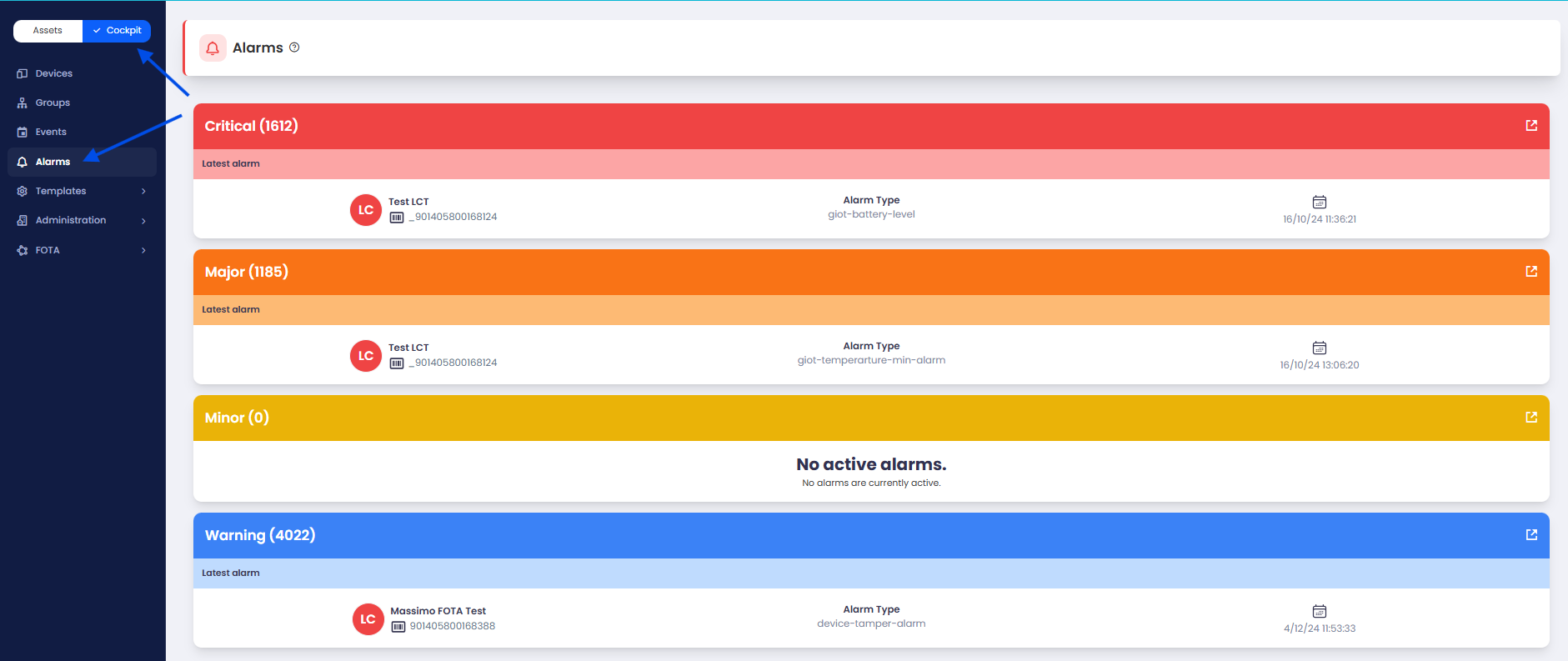
The Alarms Summary page provides a summary of alarms for either a selected device or a group of devices. It allows users to view the number of active alarms per severity level and provides key information such as the alarm type and trigger time.
## Steps to Access to Alarms Cards
1. From the **Device Alarms** front page to **View Alarm Details**:
* To explore detailed actions or associated information for an alarm, click the **arrow icon** on the relevant alarm card.
2. **Navigate to Alarm Pages**:
* The arrow icon redirects you to the **Device Alarms Card** page, to manage alarm actions.
## Alarms Card Explanation
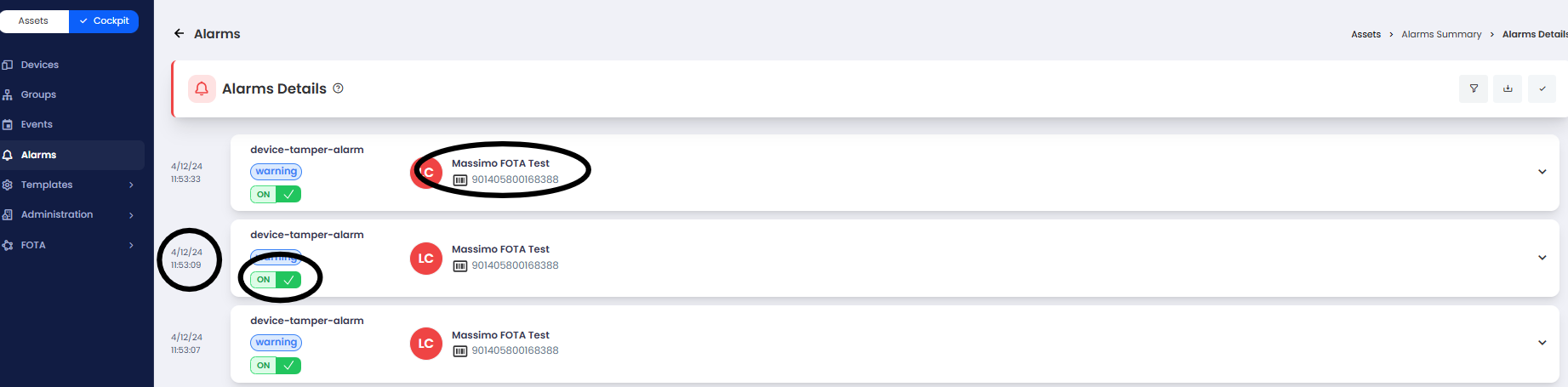
From the list of all the registered alarms, for each alarm card the user finds useful information:
1. The date and the right time when the alarm is registered,
2. The name and the series number of the device
3. That the alarm was confirmed or left open.
## Manage Alarm Status
The **Alarm Status Management** page enables users to monitor and manage alarms generated by device configurations. It provides a comprehensive list of alarms, displaying their **status** (completed or ongoing) and allowing updates as necessary.
## Steps to Access to Alarm Detail Page
1. **From the Alarms Summary Page**:
* To view all alarms reported by a device, click the **“Show Alarms”** icon located in the top-right corner of each Alarm Level card.
2. **Alarms Details Page**:
* This page displays a detailed list of all active alarms, including:
* Device Name
* Alarm Level
* Alarm Status
* Specific Alarm Triggered
Alarms Detail's Function
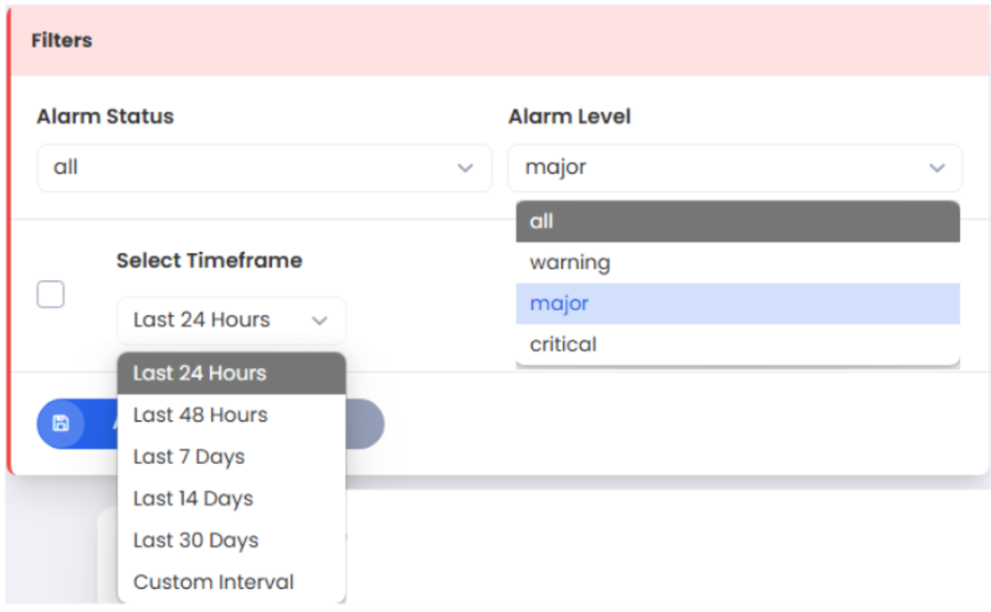
#### Filters
1. **Alarm Status**:
* **ON**: Indicates the alarm has been triggered and is actively monitoring a condition (e.g., temperature exceeded, motion detected, geofence entered).
* **OFF**: Indicates the alarm condition has been resolved, cleared, or acknowledged. The event has either stopped, been corrected, or manually turned off.
2. **Alarm Level**:
* **Critical**
* **Major**
* **Warning**
* **All**: View all alarms regardless of severity level.
3. **Timeframe**:
* Select a specific period for alarm data, then click **Apply** to save and filter the results.
FIlter Icon
#### 4. Export Alarms Data
* Click the export icon to download either the entire list or a filtered subset of alarms for further analysis or record-keeping.
Export Icon
5. Confirm Alarm:
* Opens the **Update Alarm Status** panel, allowing the user to confirm or resolve all alarms.
* Click **Update** to save the changes.
---
# Agent Instructions
This documentation is published with GitBook. GitBook is the documentation platform designed so that both humans and AI agents can read, navigate, and reason over technical content effectively. Learn more at gitbook.com.
## Querying This Documentation
If you need additional information that is not directly available in this page, you can query the documentation by asking a question.
Perform an HTTP GET request on the following URL with the `ask` and `goal` query parameters:
```
GET https://docs.g-iot.io/platform-user-guide-book/alarms.md?ask=&goal=
```
`ask` is the immediate question: it should be specific, self-contained, and written in natural language.
`goal` is what the user is ultimately trying to achieve, the reason they need the answer. Sharing it helps GitBook give you a better, more relevant answer. A goal is most helpful when it describes the outcome the user wants rather than restating the question. For example, with `ask=how do I create an API token`, a goal like `automate deployments from our CI pipeline` lets GitBook tailor the answer to that use case.
The response will contain a direct answer to the question and relevant excerpts and sources from the documentation.
Use this mechanism when the answer is not explicitly present in the current page, you need clarification or additional context, or you want to retrieve related documentation sections.
 2. **Navigate to Alarm Pages**:
* The arrow icon redirects you to the **Device Alarms Card** page, to manage alarm actions.
## Alarms Card Explanation
2. **Navigate to Alarm Pages**:
* The arrow icon redirects you to the **Device Alarms Card** page, to manage alarm actions.
## Alarms Card Explanation