> For the complete documentation index, see [llms.txt](https://docs.g-iot.io/llms.txt). Markdown versions of documentation pages are available by appending `.md` to page URLs; this page is available as [Markdown](https://docs.g-iot.io/platform-user-guide-book/device/device-dashboard-details/device-configuration.md).
# Device configuration
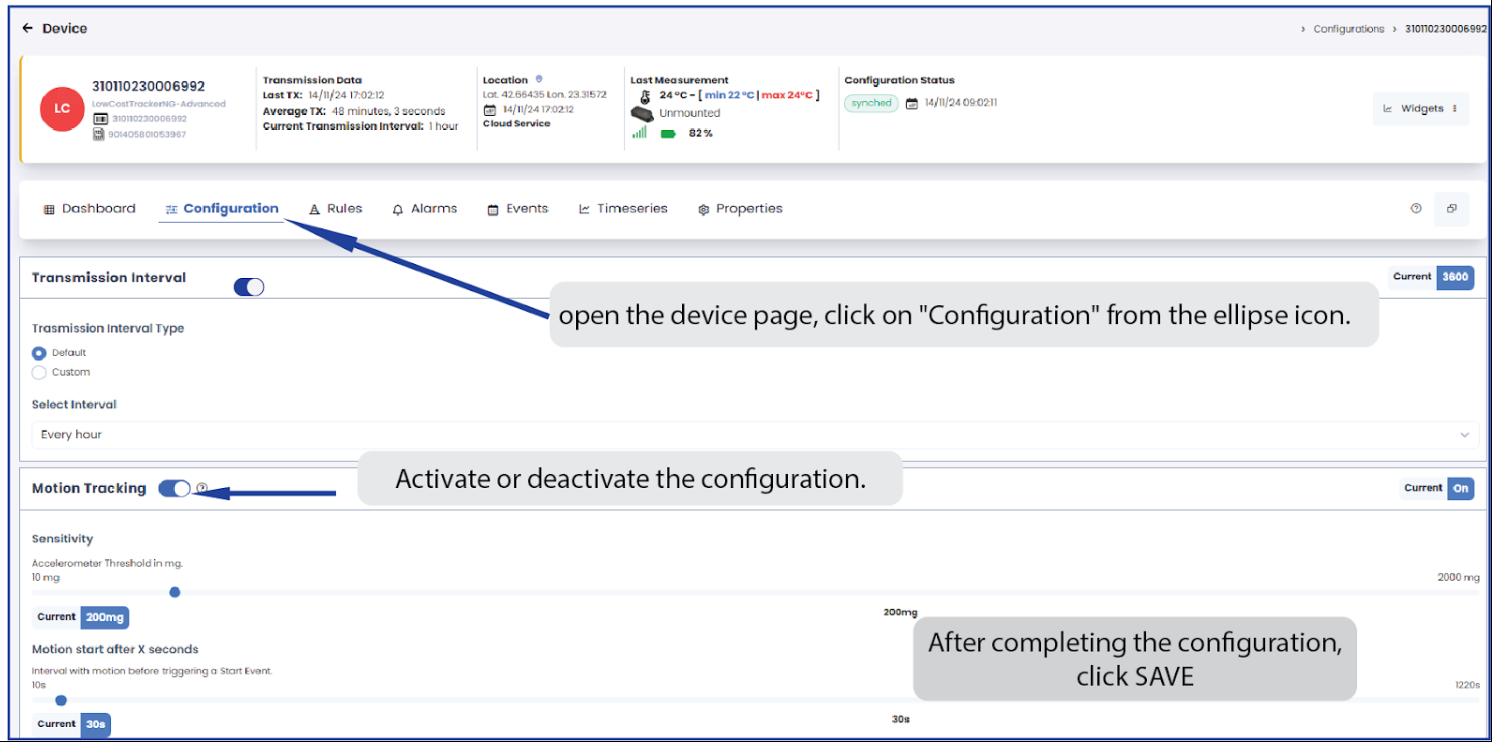
Configuration Widgets display the most recent synced configuration, which initially aligns with the device’s bootstrap settings.
The user can Activate the device configuration clicking on the toggle switch.
If any widget settings are modified, a "configuration pending" status will appear. To update the device configuration, the next time it connects to the GiOT backend, click **SAVE.**
Device Configuration
## (LM) Level Meter Configuration
* **Transmission Interval:** Specifies how frequently level data is sent.
* **Level Detection:** Enables users to set threshold values for alarm triggers, such as transmission time interval, empty distance, warning distance, and critical distance.
{% hint style="success" %}
Learn more: [https://app.gitbook.com/o/DKrl40rifuf7Bl8WIqXK/s/fEQ6KpTjmszWVWQqgcEa/\~/changes/68/level-meter-full-device-guide-book/level-meter-greater-than-giots-function/lm-configurations](/level-meter-full-device-guide-book/level-meter-greater-than-giots-function/lm-configurations.md)
{% endhint %}
## (LCT) Low Cost Tracker Configuration
* **Transmission Interval:** Determines the frequency of data transmission.
* **Temperature Monitoring:** Enables tracking of temperature readings.
* **Motion Detection:** Detects device movement.
* **Freefall:** Monitors occurrences of freefall, useful for orientation or impact sensitivity.
* **BLE Beacon:** Acts as a Bluetooth Low Energy beacon for proximity detection and location services.
* **Time-Driven Configuration:** Allows users to disable specific events for a defined period to conserve battery and avoid false alarms. Options include disabling freefall tracking, motion start/stop, tamper alerts, temperature threshold alerts (both high and low), and Bluetooth beacon signals.
These configurations help tailor the platform to specific operational requirements, enhancing monitoring and control capabilities for each device type.
{% hint style="success" %}
Learn more : [https://app.gitbook.com/o/DKrl40rifuf7Bl8WIqXK/s/fEQ6KpTjmszWVWQqgcEa/\~/changes/68/low-cost-tracker-full-device-guide-book/low-cost-tracker-greater-than-giots-functions/lct-configuration](/low-cost-tracker-full-device-guide-book/low-cost-tracker-greater-than-giots-functions/lct-configuration.md)
{% endhint %}
---
# Agent Instructions
This documentation is published with GitBook. GitBook is the documentation platform designed so that both humans and AI agents can read, navigate, and reason over technical content effectively. Learn more at gitbook.com.
## Querying This Documentation
If you need additional information that is not directly available in this page, you can query the documentation by asking a question.
Perform an HTTP GET request on the following URL with the `ask` and `goal` query parameters:
```
GET https://docs.g-iot.io/platform-user-guide-book/device/device-dashboard-details/device-configuration.md?ask=&goal=
```
`ask` is the immediate question: it should be specific, self-contained, and written in natural language.
`goal` is what the user is ultimately trying to achieve, the reason they need the answer. Sharing it helps GitBook give you a better, more relevant answer. A goal is most helpful when it describes the outcome the user wants rather than restating the question. For example, with `ask=how do I create an API token`, a goal like `automate deployments from our CI pipeline` lets GitBook tailor the answer to that use case.
The response will contain a direct answer to the question and relevant excerpts and sources from the documentation.
Use this mechanism when the answer is not explicitly present in the current page, you need clarification or additional context, or you want to retrieve related documentation sections.