> For the complete documentation index, see [llms.txt](https://docs.g-iot.io/llms.txt). Markdown versions of documentation pages are available by appending `.md` to page URLs; this page is available as [Markdown](https://docs.g-iot.io/platform-user-guide-book/device/device-page-introduction.md).
# Device Page Introduction
The **Device Dashboard** is your central hub for monitoring and managing an individual device. From here, you can view real-time data, add and customize widgets (such as location, temperature, or battery status), access the device’s rules, events, alarms, and configuration settings.
**How to access**
1. Navigate to the **Cockpit** menu.
2. Click on **Device**.
3. The page displays the complete list of devices associated with the tenant.
### **Filter**
The Filter function allows users to refine the device list using multiple criteria, providing full flexibility and visibility to create a customized device view. Once a filter is applied, the resulting list can also be exported using the **Export** function.
#### Filtering options
1. Click the **Filter** option located in the top-right corner of the page (funnel icon).
2. Select one or more filter criteria.
3. Click **Apply** to display the filtered device list.
#### **Available filter options**
* **Device type**
* **Device group**
* **Status**:
* Active
* Online
* Offline
* Configuration update pending
* Last online
* Exchanged (device has been successfully replaced by a new one; see the *Exchange* section of this guide)
* **Planned for exchange**
* If the tenant has the required permission, users can enable *Show only devices planned for exchange*.
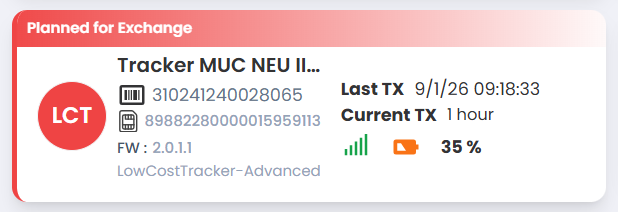
* These devices are also visually identifiable by a red banner on their device card.
* **Firmware version**
* **Battery level** (selectable via slider)
* **Faulty battery** (checkbox to show devices with battery issues)
* **TX interval** (enter the desired interval value)
{% hint style="info" %}
Filtering helps build precise device lists for monitoring, troubleshooting, and reporting. Filtered results can be exported for further analysis or sharing.
{% endhint %}
### **Export a file**
export the filtered list or a file as a .CSV or .JSON file.
### Sorting
Users can sort the device list by clicking on the **up and down arrows** displayed next to each sortable column. This allows the list to be reordered in either ascending or descending order based on the selected field.
**Sortable fields include**
* Serial Number
* TX Interval
* Registration date
* Last uplink date
## Device Card
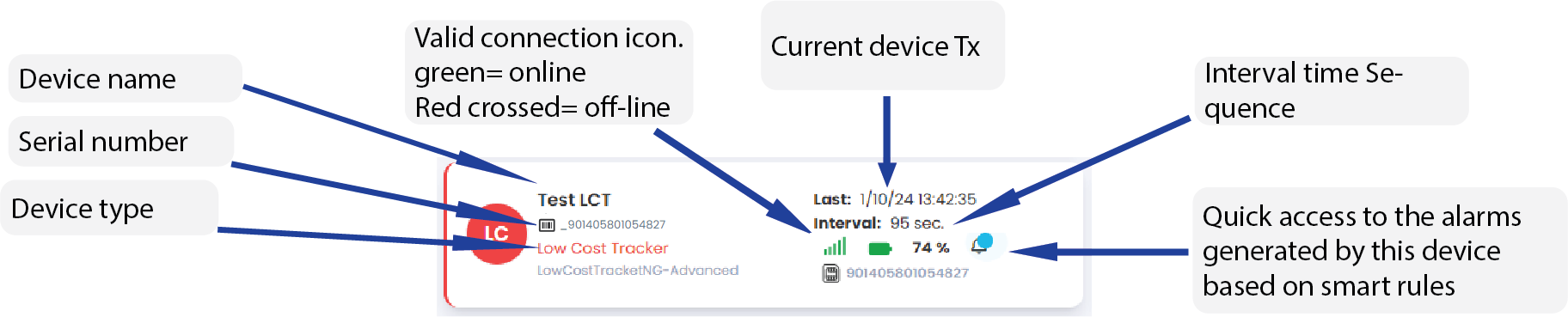
The Device Card offers a quick overview of each device’s key details, such as status, battery level, and recent data updates. It provides easy access to essential actions, allowing users to monitor, configure, and manage devices efficiently. Through the card’s menu, users can access advanced settings, rules, and configurations specific to each device.
Device Card Explanation
### Device '' Not Activated '' Activation and Migration Status
Device not activated
{% hint style="info" %}
By default, the device list is filtered to hide **Not Activated** devices. To view them, open the **Filter panel** and remove the filter.
{% endhint %}
Devices migrated from **COT Cloud** may display different statuses:
* **COT-not-ready** → Device has not bootstrapped on COT. Activation via NFC is required. ( as shown in picture above )
* **COT-ready** → Device bootstrapped on COT, and configuration changes will be sent soon.
* **COT-updated** → The new configuration has been successfully updated on COT.
* **COT-migrated** → Configuration has been sent to the device, and on the next uplink, it will appear on the Gimasi Platform.
If there are any issues, contact your **Admin** to verify the correct on boarding of the device.
### Device Card blink Yellow.
{% embed url="" fullWidth="true" %}
The device card blinks **yellow** when it is actively **receiving data** in real-time. This indicates that the device is currently communicating with the platform and updating its status.
### Device Card - Planned for Exchange
**Planned for Exchange** indicates that a device is in the process of being replaced with a newer or more multifunctional device. This functionality is part of the GIOT platform and is managed by the **Gimasi team** to support smooth hardware transitions without service disruption.
When a device is marked as *Planned for Exchange*, it means the replacement process has been initiated and the existing device is scheduled to be switched to a new target device.
From the device card, users can click on the **top red banner** to access exchange-related actions. If the tenant has been granted the required permissions, the user can:
* **Delete the device**, or
* **Merge it with the new target device**
#### **Important notes:**
{% hint style="info" %}
When a device is **merged**, existing configurations such as **rules, group assignments, and other settings are preserved** and transferred to the new device.
This ensures continuity and minimizes reconfiguration effort during device replacement.
{% endhint %}
> **Please follow the link to learn more about device exchanges.** [**here**](https://docs.g-iot.io/~/revisions/dDse6CcuAdnnenXpuqlL/platform-user-guide-book/administration/exchanges)
---
# Agent Instructions
This documentation is published with GitBook. GitBook is the documentation platform designed so that both humans and AI agents can read, navigate, and reason over technical content effectively. Learn more at gitbook.com.
## Querying This Documentation
If you need additional information that is not directly available in this page, you can query the documentation by asking a question.
Perform an HTTP GET request on the following URL with the `ask` and `goal` query parameters:
```
GET https://docs.g-iot.io/platform-user-guide-book/device/device-page-introduction.md?ask=&goal=
```
`ask` is the immediate question: it should be specific, self-contained, and written in natural language.
`goal` is what the user is ultimately trying to achieve, the reason they need the answer. Sharing it helps GitBook give you a better, more relevant answer. A goal is most helpful when it describes the outcome the user wants rather than restating the question. For example, with `ask=how do I create an API token`, a goal like `automate deployments from our CI pipeline` lets GitBook tailor the answer to that use case.
The response will contain a direct answer to the question and relevant excerpts and sources from the documentation.
Use this mechanism when the answer is not explicitly present in the current page, you need clarification or additional context, or you want to retrieve related documentation sections.