> For the complete documentation index, see [llms.txt](https://docs.g-iot.io/llms.txt). Markdown versions of documentation pages are available by appending `.md` to page URLs; this page is available as [Markdown](https://docs.g-iot.io/platform-user-guide-book/administration/exchanges.md).
# Exchanges
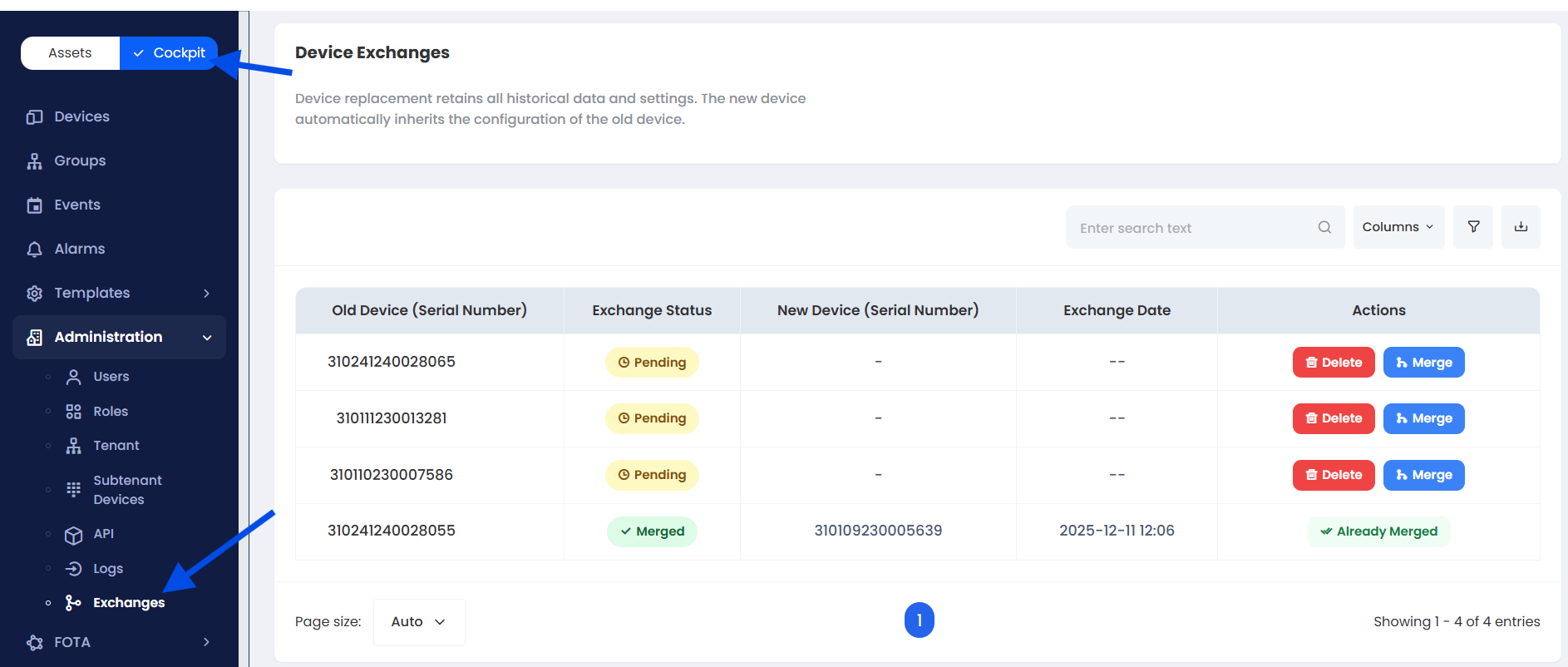
The **Exchange** section provides an overview of all devices that are currently in progress to be exchanged with a new device.
The Exchange section is designed to manage device replacement processes, ensuring continuity of configuration and controlled device lifecycle management.
Within the Exchange section, users with the required access rights can:
* View all devices that are planned or currently in progress for exchange.
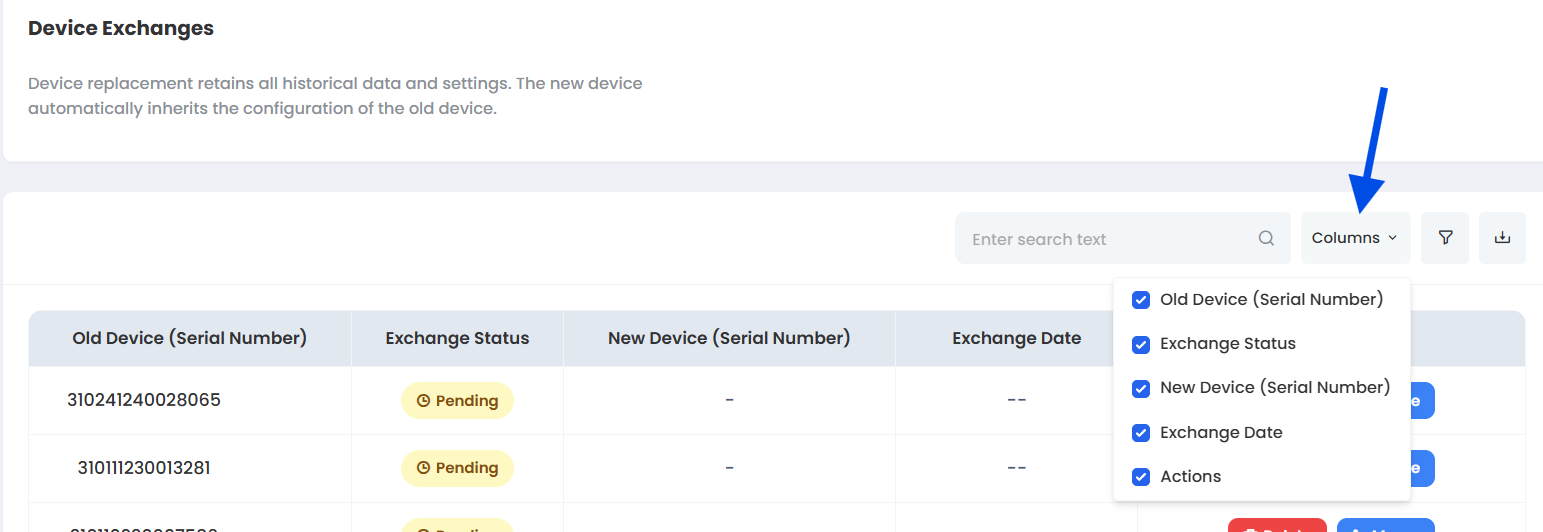
* Customize which columns are visible in the table.
* Filter, export, merge, or delete devices depending on granted permissions.
{% hint style="warning" %}
This section is **only visible to Super Admin users** with the appropriate access rights granted.
{% endhint %}
#### How to Access the Exchange Section
1. Open the **Cockpit**.
2. Navigate to **Administration**.
3. Select **Exchange**.
#### Table Columns
The Exchange table allows users to select and visualize the following columns:
* **Old Device** – The device that is being replaced.
* **Exchange Status** – Current status of the exchange process.
* **New Device** – The target device for the exchange.
* **Exchange Date** – Date when the exchange was initiated or completed.
* **Action** – Available actions based on user permissions.
#### Filtering Devices
Users can filter the device list using the following criteria:
* **Exchange Status**
* **Exchange Date – Start**
* **Exchange Date – End**
This helps quickly identify devices based on their exchange progress and timeframe.
#### Export
Users can export the list of devices displayed in the table for reporting or external processing.
#### Table Columns
The Exchange table allows users to select and visualize the following columns:
* **Old Device** – The device that is being replaced.
* **Exchange Status** – Current status of the exchange process.
* **New Device** – The target device for the exchange.
* **Exchange Date** – Date when the exchange was initiated or completed.
* **Action** – Available actions based on user permissions.
#### Filtering Devices
Users can filter the device list using the following criteria:
* **Exchange Status**
* **Exchange Date – Start**
* **Exchange Date – End**
This helps quickly identify devices based on their exchange progress and timeframe.
#### Export
Users can export the list of devices displayed in the table for reporting or external processing.Actions
If the user has the required permissions, the following actions are available:
### Actions – Merge or Delete Device
This section describes the actions available for devices that are in progress of being exchanged.\
The available actions depend on the user’s role and granted permissions.
{% hint style="warning" %}
Only users with the appropriate granted permissions can see and use the **Merge** and/or **Delete** actions. Users without permissions will not see these actions at all.\
To enable these functions, please contact the **GIMASI Administration** team to request access activation.
{% endhint %}
**Delete Device**
* Completely removes the old device from the tenant.
* The device and all related data are permanently deleted.
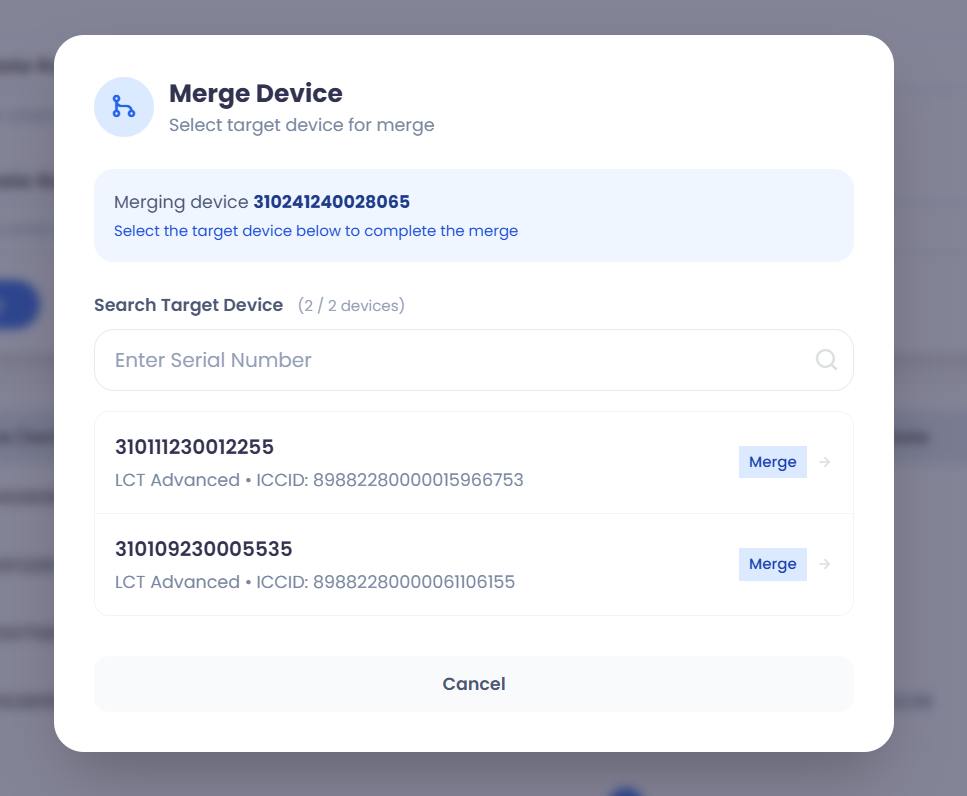
**Merge Device**
* Merges the old device into a selected new device.
* **All configurations** (rules, groups, settings, and assignments) from the original device are retained.
* The device name is updated **only if the serial number in the name is complete**:
* If the full serial number is present, the name will be updated with the new serial number.
* If the serial number is incomplete, the device name will **not** be changed.
When clicking **Merge**, a popup dialog is displayed showing a list of available new device serial numbers that can be selected for merging.
---
# Agent Instructions
This documentation is published with GitBook. GitBook is the documentation platform designed so that both humans and AI agents can read, navigate, and reason over technical content effectively. Learn more at gitbook.com.
## Querying This Documentation
If you need additional information that is not directly available in this page, you can query the documentation by asking a question.
Perform an HTTP GET request on the following URL with the `ask` and `goal` query parameters:
```
GET https://docs.g-iot.io/platform-user-guide-book/administration/exchanges.md?ask=&goal=
```
`ask` is the immediate question: it should be specific, self-contained, and written in natural language.
`goal` is what the user is ultimately trying to achieve, the reason they need the answer. Sharing it helps GitBook give you a better, more relevant answer. A goal is most helpful when it describes the outcome the user wants rather than restating the question. For example, with `ask=how do I create an API token`, a goal like `automate deployments from our CI pipeline` lets GitBook tailor the answer to that use case.
The response will contain a direct answer to the question and relevant excerpts and sources from the documentation.
Use this mechanism when the answer is not explicitly present in the current page, you need clarification or additional context, or you want to retrieve related documentation sections.