> For the complete documentation index, see [llms.txt](https://docs.g-iot.io/llms.txt). Markdown versions of documentation pages are available by appending `.md` to page URLs; this page is available as [Markdown](https://docs.g-iot.io/platform-user-guide-book/administration/user/create-new-user.md).
# Create New User
The **Create New User** page allows Super Admins or permitted roles to onboard new users into the platform.\
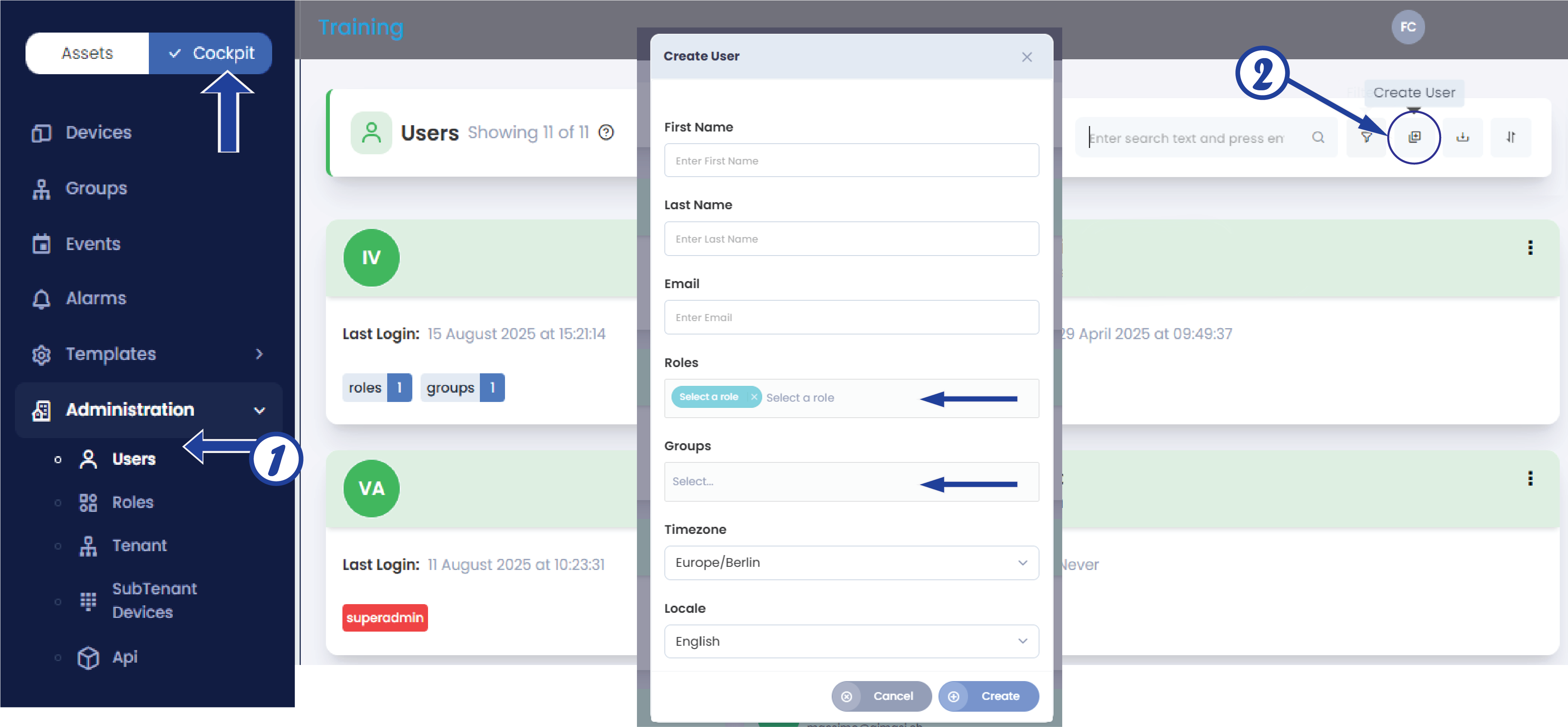
During the creation process, it's essential to define the user's role and group access — both are mandatory for restricted users. Only one role can be assigned per user. You can either assign a specific group or give access to **All Groups**, which overrides any individual group selection.
Before assigning a **custom role**, ensure it has been previously created (see: *Create New Role*). Once all required fields are filled and settings confirmed, the user will receive an activation email to complete their registration.
### Steps to Create a New User
**1. Initiate User Creation**\
From the **User Management** page, click on **Create User**.
**2. Fill in User Details**\
Enter all required information, including the user’s **email address**, **first and last name**, and any optional details.
**3. Assign Groups or All Groups**\
You must now assign the user to either:
* **Specific Groups** (one or more), or
* **All Groups** (exclusive — no other group can be assigned if this is selected).
{% hint style="info" %}
Assigning a user to "All Groups" will automatically remove any previously selected individual groups.
{% endhint %}
**4. Assign Initial Role and Group Access**\
Select a predefined or custom role for the user.\
If you're assigning a **custom role**, ensure it’s been created beforehand (see: *How to Create Roles*).
Next, assign the group or groups the user will have access to.\
For each assigned group, you must also specify the **access level**:
* **Read**: The user can view data and dashboards but cannot modify device settings or platform configurations.
* **Write**: The user has full permission to modify devices, rules, dashboards, and other elements within the assigned group(s).
{% hint style="info" %}
If you're assigning a **custom role**, ensure it’s been created beforehand. You can learn how to create roles [here.](https://docs.g-iot.io/platform-user-guide-book/administration/role/create-new-role)
{% endhint %}
**5. Select Language Preference**\
Choose the user’s preferred language from the dropdown list.
**6. Automatic Tenant Assignment**\
The platform will automatically assign the **current tenant** to the user.
**7. Confirm Creation**\
Click **Create** to finalize the process. The user will receive an **activation email** to set up their password and log in.
### **Role & Group Assignment Rules:**
* **Only one role** can be assigned per user.
* For **restricted users** (non–Super Admins), assigning them to **at least one group** is **mandatory**.
* If the user is assigned the "**All Groups**" option:
* All other group assignments will be **automatically removed**.
* The user will gain access to all current and future groups within the Tenant.
* These rules ensure clarity in user access, improving organizational structure and minimizing risk.
{% hint style="warning" %}
\*IMPORTANT: Only super Admins or Users with account privileges can add new users.
{% endhint %}
---
# Agent Instructions
This documentation is published with GitBook. GitBook is the documentation platform designed so that both humans and AI agents can read, navigate, and reason over technical content effectively. Learn more at gitbook.com.
## Querying This Documentation
If you need additional information that is not directly available in this page, you can query the documentation by asking a question.
Perform an HTTP GET request on the following URL with the `ask` and `goal` query parameters:
```
GET https://docs.g-iot.io/platform-user-guide-book/administration/user/create-new-user.md?ask=&goal=
```
`ask` is the immediate question: it should be specific, self-contained, and written in natural language.
`goal` is what the user is ultimately trying to achieve, the reason they need the answer. Sharing it helps GitBook give you a better, more relevant answer. A goal is most helpful when it describes the outcome the user wants rather than restating the question. For example, with `ask=how do I create an API token`, a goal like `automate deployments from our CI pipeline` lets GitBook tailor the answer to that use case.
The response will contain a direct answer to the question and relevant excerpts and sources from the documentation.
Use this mechanism when the answer is not explicitly present in the current page, you need clarification or additional context, or you want to retrieve related documentation sections.